
Total Hip Replacement
Physio turns Patient! My Experience undergoing a Total Hip Replacement
Never did I imagine that I would be lining up to have a total hip replacement at my age. I am very aware that I am getting older but it still feels a bit out of place.
I thought it might be helpful to give my account of going through this procedure, what I found hard and what I also found useful in the hope that it may help others when faced with an impending joint replacement.
How did I develop Osteoarthritis in my hip?
There are several factors involved in this answer. I played a lot of hockey and sport when I was younger but had a change in sporting direction when I went to Dunedin for study. I got involved more in running, which then transitioned to triathlon and then eventually focused more on cycling. I was lucky enough to be able to take this a step further and race professionally overseas for a number of years. As tends to go with the territory, I had a few crashes during that time. No broken bones but I do remember always landing on my right side and one crash ended in my hip getting pulled out sideways. This resulted in a labral tear (protective lining for your hip that helps with joint stability). At this time, I also found out that I have particularly shallow hip joints (borderline Hip dysplasia).
The combination of all these factors results in decreasing the stability of the joint, the labral tear exposing the joint surfaces leading to cartilage damage and essentially the start of osteoarthritis.
At the time of the initial injury the hip was quite painful but eventually settled and I was able to run, cycle, tramp, play with the kids and swim. Only in the last couple of years has the above all caught up with me, where I developed pain and restriction of movement leading to limitation of activities and sport.
Deciding to go ahead with surgery
My choice to go ahead with the surgery was made around the thought that my hip was only going to be get worse, more dysfunctional and it was getting hard to keep the area strong. I did some research on the different procedures and opted to go with an Anterior approach (DAA) rather than the more traditional posterolateral approach. The Anterior approach has a faster recovery, less post-surgery restrictions and is more stable overall. It also doesn’t disrupt the gluteal muscles quite so much, which is a good thing.
I was anxious leading into the Surgery, not really knowing if I had made the right decision, not really knowing what it was going to feel like afterwards and as is always the case with surgery there can be complications. It also doesn’t pay to watch or think too hard about what the procedure involves and just leave that up to the surgeon!
As a Physiotherapist turned patient… here are some of the key things I learned from this experience:
- Don’t delay too long in making a decision. Don’t wait so long for the surgery that your world becomes narrower due to the limitations in function, pain and the dysfunction you start to develop such as moving differently. The more severe the osteoarthritis (OA) becomes the unhealthier your muscles and tendons become, making it harder to get a good post-surgical outcome. I have done a bit more reading around this area lately and it appears that we should be doing surgery at stage 3 rather than 4 OA because of the changes that start to take place in the muscles that can become irreversible.
- Get into your ‘Pre-hab’. Strengthening and conditioning the area as much as you can prior to the surgery will help with recovery for the affected and the unaffected leg.
- Old sayings ring true: “Patience is a virtue.” “Time is a healer.” Healing takes time and I think it is helpful to think about progression in terms of weeks rather than days.
This also applies to time with crutches. I was a little surprised at how long it took before I felt like I could lose the crutch for good – 4 ½ weeks. I did have a few thoughts about whether I would ever walk normally again!
- It takes time for muscle function, proprioception (awareness of where your joint is in space) and confidence to come back.
- If possible, hire a Game Ready machine for post-surgery. It is a machine that uses a wrap that then fills with cold and compression around the area and really helps with pain and swelling management – it really was a game changer for me.
- Small regular bouts of movement are helpful even if it feels weird.
- Use pain relief. Surprisingly Panadol when taken regularly really helps. You’ll be prescribed different pain relief levels depending on pain. Pain impacts your sleep and sleep is important for recovery so if you are comfortable, you will sleep, and this obviously flows onto your recovery.
- Do your exercises. I found it so helpful (both physically and mentally) when I could start doing some cycling and swimming again and slowly adding some gym work in again (mostly upper body to begin but over time more for the lower body).
- Follow up with your Physio post-surgery. Even in the early days you have lots of questions, there will be bruising in other areas that is uncomfortable and your physio can help with this. They are also very good with advice around movement, reassurance and pain modulation.
I’m now 9 weeks in and it will probably take around 18months for the new hip to fully settle in, but I know I’m making good progress and feel hopeful of getting back into being able run around with the kids, to walk some of the Great walks, Cycle the epic trails around NZ and have fun!
Most of us don’t get to ski as much as we would like, which means the body is thrown into a new movement for a lot of hours at a time. As the muscles fatigue, skiing gets harder, the chance of having a fall goes up, and the ability of the muscles to support the fall goes down.
To learn more about different ski injuries and injury prevention check out our recent article called ‘Get Ready for Skiing’. It explains the importance of improving muscle strength to prevent injuries when you’re out on the snow. Putting thought and effort into preparing your body for skiing is going to be one of the key ways to make any upcoming skiing more enjoyable and hopefully injury free.
Below I outline some suggested skiing exercises to get started with your strength and conditioning at home, even if you only have a few minutes.
3 primary areas of focus
There are 3 main components to an exercise programme for skiing – leg strength, core strength, and dynamic balance (see ‘Get Ready for Skiing‘ for more detail). Each play an important part in skiing well and injury prevention.
Below are some exercise suggestions translating these three components into a programme. I have selected exercises that can be completed at home and will be generally challenging but achievable for most skiers. Of course, there is a lot of variation in personal circumstances and so many modified versions of these exercises exist. If they are not feeling right feel welcome to adapt them to your needs or come into the clinic for a more personalised programme. I have included some brief instructions and explanations, but all exercises are easily searchable for a more in-depth tutorial.
1. Single leg sit to stand from chair:
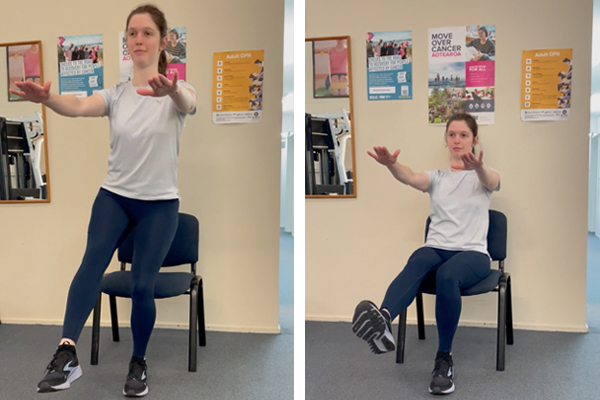
Start standing by a chair, couch or box like you are going to sit down into it. Lift one leg from the ground and hold it out in front of you. Lower down into the chair on the single leg, the same movement as if you are sitting down into it, keeping the hips square to the front and knee in line with toes. Control the movement as much as possible and sit down into the chair. You may want to start with just this component, focusing on improving the control through your hip and knee. When you are ready you can also try standing up out of the chair with the same movement, while trying to avoid twisting through the hip and knee. While challenging at first you will be surprised at how quickly your hip and knee control improves and how much stronger you feel through the movement.
Other variations of this movement you can try are: Lateral step downs (easier), Romanian split squat or pistol squat (harder).
2. Side Plank:
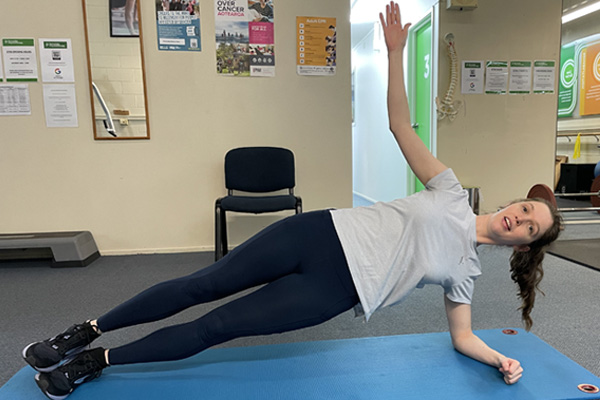
Start lying on your side on the floor. Line up your head, shoulders, hips and feet. Place your elbow directly below your shoulder with your forearm flat on the floor. To start, push your hips away from the floor so only your forearm and feet are contacting the ground, make sure you are keeping your body in a ‘plank’ shape with shoulders, hips and feet in a straight line. Keep the hips high and in line, you should feel this working in the side of your core, hip and down the side of your leg. Hold for as long as you can maintain form, then change sides.
Other variations: Half side plank (easier), side plank with hip abduction (harder).
3. Jump Squats:
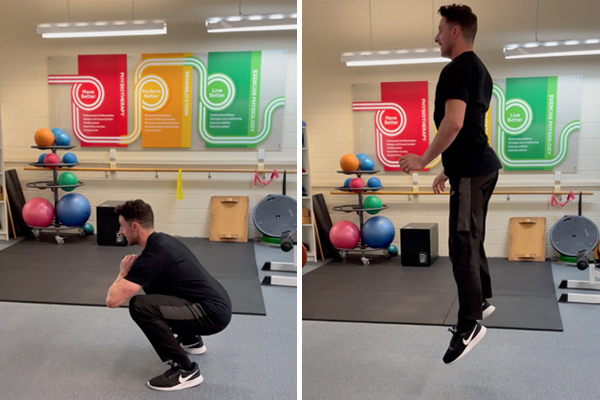
Start by squatting as you normally would, then power up out of the squat transitioning directly into a jump. Land the jump focusing on landing lightly and smoothly sinking into your next squat as you absorb the force. Also focus on landing and pushing evenly between both legs. This will be a big step up from normal squatting so take your time and focus on quality over quantity.
Other variations: skipping/jumping (easier) deficit jumps/single leg hops off a step (harder).
Generally, to get improvement you need to be doing 3 sets of 5-12 reps of these exercises 3-4 times per week. The key is that you should be feeling tired by the end of each set and be doing it often enough that the body will adapt. The advantage of these exercises is that they are easy to get done quickly and with a bit of planning can be incorporated into your day or pre-existing workout.
For additional support, along with an exercise programme personalised to you, book in with your physio here at Ponsonby Physio.
Happy Skiing!
Whether you are an expert skier or a beginner, it’s worth putting some thought into preparing for the season. Improving your strength and stability at home will have the benefit of improving your performance and helping prevent injury when you get onto the snow.
Common Ski Injuries
Often we see knee injuries from the knee twisting when falling over. Twisting and inwards (valgus) force knee injuries are very common for skiers to sustain due to how the ski twists when falling or in the case of a collision, someone else impacting from the outside. Several structures in the knee such as your MCL, ACL, and meniscus are susceptible to the loaded twisting movement that occurs. Some of these incidents will be too high energy to control, especially if the element of surprise overwhelms the knee. But with lower energy impacts or circumstances where you have some warning the ability of your muscles and your brain to control the forces around the knee can make all the difference.
The Importance of Strengthening Muscles
Improved muscle strength can enable the knee to effectively splint itself during falls and binding releases, and prevent injury to these important structures of the knee.
Strength exercises can also help prevent muscle fatigue throughout the day. Most of us don’t get to ski as much as we would like which means the body is thrown into a new movement for a lot of hours at a time. As the muscles fatigue, skiing gets harder, the chance of having a fall goes up, and the ability of the muscles to splint and support the fall goes down. Having more consistent exposure to the movements through some strengthening at home means the muscles will be able to maintain more strength and protection in your knees throughout the day, and you will likely enjoy your skiing more because of it.
Check Ski Bindings
Whether your binding releases properly or not can make the difference with a potential injury because the torque generated in your leg from the long lever arm of a ski is large. If you are looking at buying bindings it is worth paying attention to how effectively they release and in how many directions. Additionally, having properly adjusted ski bindings is essential, as excessively high settings increase the likelihood of overwhelming the knee during a release. When looking at injury prevention not only do you want to work on conditioning your body for skiing, but also controlling these kinds of external factors as much as possible.
What to focus on to get ready for skiing
If you’ve checked your bindings, and you now know how important strong muscles are, the next step is to start strengthening those muscles.
Considering how fall injuries happen when skiing translates directly into what areas of the body and exercises to focus on. There are 3 main requirements for a ski strength programme – leg strength, core strength, and dynamic balance. Each play an important part in skiing well and injury prevention.
Regarding leg strength, it is worth noting that while skiing is predominantly a sport where you are using both legs together, at the point of injury it is often about being able to balance and control the leg and ski in a single leg position. So include both double leg movements like squats, and single leg exercises too.
The goal for core strength is to provide a solid base for movement. Performance in almost any sport can be improved with good core stability as less uncontrolled movement in the torso means the body can generate more power quickly, control where its centre of gravity is going and overall fine-tune its control. In skiing the movement is often sideways so special attention to the obliques and getting the core to work together with the glutes and other muscles down the side of your body is important.
Finally, dynamic balance is all about how all this comes together, you need to be able to use your muscles exactly when you need them with the right amount of power and control to get out of a sticky situation. A lot of skiing is controlling sudden changes in movement and any practice in coordinating jumping, landing and twisting movements means you will perform much better when doing this while skiing.
Check out our next article ‘3 Exercises for Skiing‘ that outlines suggested ski exercises!
If you would like help to get ready for skiing with a personalised strength programme, or you have a ski related injury that needs attention, come in and see us at Ponsonby Physio.
Photo credit: Nicolai Berntsen
Exercise Immunology – what is it?!
Within a time where health and illness have been such a prominent part of our lives, and at the forefront of everyone’s mind, it is even more important to keep our immune system as strong as possible. The latest research in the field of exercise immunology is super interesting and very relevant to us all.
So what is ‘exercise immunology’? Well, formally it’s defined as the ‘Field of study on the interactions of physical, environmental, and psychological factors on immune function’. Basically the effect of factors like exercise, stress, and diet on our immune system. And can exercise boost your immunity? The answer is yes. The immune system is actually very responsive to exercise. Exercise has been proven to be capable of improving regulation of the immune system and enhancing immune defence activity and metabolic health.
Major findings in Exercise Immunology
Some of the key exercise immunology discoveries made in the last few years provide insight on how the amount, intensity and frequency of exercise affect us.
Acute exercise, which is defined as moderate-to-vigorous intensity for less than 60 minutes, is now viewed as an important immune system adjuvant. This level of exercise stimulates the ongoing exchange of highly active immune cells between the circulation and tissues. For each exercise bout improves the antipathogen activity of tissue macrophages, immunoglobulins, anti-inflammatory cytokines, neutrophils, NK cells, cytotoxic T cells, and immature B cells. With near daily exercise, these acute changes operate through a summation effect to enhance immune defence activity and metabolic health.
Interestingly, in contrast to this, research has also shown high exercise training such as competition events, and the associated physiological, metabolic, and psychological stress that are linked with these, actually create the opposite affect and distress your immune system, increase systemic inflammation, oxidative stress, and muscle damage, and therefore increase illness risk. So the amount of exercise and level or load of exercise you are doing is important to note when regarding your immune system health.
Studies are also suggesting that regular physical activity is associated with decreased mortality, and decreased incidence rates for influenza and pneumonia. This is because regular exercise training also has an overall anti-inflammatory influence mediated through multiple pathways. The evidence suggests that the circulation surge in cells of the immune system with each exercise bout, and the anti-inflammatory and antioxidant effect of exercise training, have a summation effect over time in modulating chronic disease processes.
So putting it simply, doing regular exercise – almost daily bouts of 30-60 minutes of moderate exercise – has been proven to strengthen your immune system’s function. As well as the already well-known benefits on your mental health by decreasing depression and anxiety related conditions and stress.
If you have an injury that is hindering your ability to move, are in pain or discomfort, or you are needing some advice on how to start moving in a safe and effective way for you, then contact our team at Ponsonby Physio. Our physios are experts in movement strategies and are passionate about helping you, and sharing our combined knowledge to get you moving again.
Reference to: The compelling link between physical activity and the body’s defence system. Author links open overlay panel. David C.Niemana Laurel M.Wentzb